
Lieutenant General J F R Jacob, Chief of Staff, Eastern Army Command during the 1971 war, revealed how, armed with only a draft surrender document and an aide, he made the Pakistani army led by Lieutenant General A A K Niazi surrender.
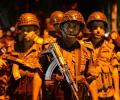
All the hostages killed during the 12-hour siege by Islamic State terrorists were foreigners, with most being Italian or Japanese.
Lieutenant General J F R Jacob, Chief of Staff, Eastern Army Command during the 1971 war, reveals how, armed with only a draft surrender document and an aide, he made the Pakistani army led by Lieutenant General A A K Niazi surrender.

On the title page of the Top Secret Report, Henderson-Brooks quotes the Chinese tactician Sun Tzu: 'Know yourself, know your enemy: A hundred battles, a hundred victories', says Claude Arpi, highlighting where the Indian Army and government failed to counter the Chinese attack in 1962.
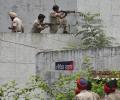
Seven people, including two police officers and a terrorist, were killed as the Punjab Police's elite Special Weapons and Tactics team and the Indian Army were carrying out a massive operation in the Gurdaspur district to flush out terrorists who went on a rampage attacking a bus and a police station complex.

'...by combining religious and political missions -- to destroy the Babri Masjid and establish Ram Rajya.' 'Hindutva was successful in creating synergy with the aspirations of devotees,' Dhirendra K Jha, author of Ayodhya: The Dark Night, tells Kanika Datta.

'The sky is the limit for what all could be done at an air base to neutralise terrorists. Good proactive local leadership and delegated operational effort would be key to ensuring that a handful of terrorists cannot hold a whole air base, and by extension, the whole nation to ransom,' says Group Captain P I Muralidharan (retd).

Vinita Bisht and Vinita Kamte lost their husbands -- one an NSG commando, the other an IPS officer -- in the 26/11 terror attack. Six years later, Archana Masih/Rediff.com meets them to discover that closure is one of the hardest things to find.

Fresh tremors were on Sunday felt in various parts of India, including the national capital Delhi, even as the death toll in Saturday's earthquake climbed to 62.

The President talked about demonetisation, electoral reforms and disruptions in Parliament.

The issue of lynchings resonated in the Rajya Sabha; while in the Lok Sabha, the Opposition accused the government of not being sensitive towards farmers' issues.

'India placed the order, primarily due to the IAF's 'critical operational necessity'.' 'The complexity of the IAF's requirements delayed the process for months.' 'It is these requirements which cannot be made public.' 'Can you image Indian politicians publicly discussing the pros and the cons of such military equipment?' 'It would provide India's enemies with indications about the IAF's tactical plans in case of a conflict.' 'It is crucial that they should remain secret to protect India's defence preparedness,' explains Claude Arpi.

Is Shivraj Singh Chouhan paying the price of being in the wrong camp? Aditi Phadnis and Shashikant Trivedi find out.

Bharata Natyam legends Shanta and V P Dhananjayan discover they are a national sentation after their Vodafone ads.

The year 2014 is coming to an end. It was the year of conflict, the year of strife. Year 2014 will be remembered for several reasons -- the rise and threat of the Islamic State, the downing of two Malayasia Airlines aircraft and the sudden and effective way of using hastags on social media to generate a buzz about the event. After all, who can forget #theicebucket challenge and the phenomenon it grew into. Read on as we bring you an overview of international news and events of 2014.
